
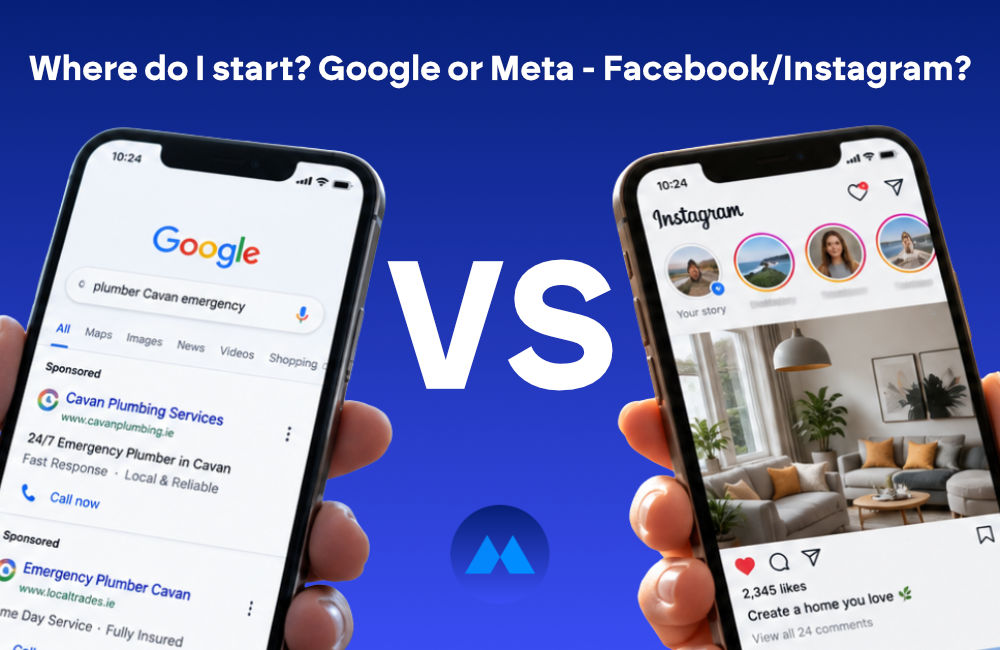
Google Ads vs Meta Ads: Which Should You Start With?
Ask five people whether your business should start with Google Ads or Meta Ads and you'll probably get five different answers. Everyone has a favourite platform, a success story or a strong opinion. None of that necessarily helps you decide where to spend your own marketing budget.
A more useful question is: how do your customers behave before they buy?
Are they actively searching because they already have a problem to solve, or are you trying to reach them before they've started looking?
That distinction matters because Google Ads and Meta Ads can play very different roles in the customer journey. Choosing between them isn't really about which advertising platform is “better”. It's about matching the platform to customer intent, your offer and the job your advertising needs to do.
In Part 1, we'll look at the Google Ads side of that decision: when paid search makes sense, which businesses are particularly suited to it, and what needs to be in place before you start spending.
The One Question That Decides Where You Should Advertise
Before comparing costs, clicks or targeting options, start with one simple question:
Do your customers actively search for what you offer when they need it?
If the answer is yes, Google Ads may be the more logical place to start. Someone searching Google for a service is already expressing intent. They have a problem, they are looking for a solution, and your business has an opportunity to appear at exactly that moment.
Think about someone who needs an emergency plumber, an accountant, a dentist or a local tradesperson. They are unlikely to wait for the right business to appear in their social media feed. They search.
This is the fundamental strength of Google Ads: it doesn't have to create the initial demand. It can put your business in front of people who are already looking for a solution.
Why Google Ads Makes More Sense for Some Businesses
Search intent isn't equally valuable for every business.
Google Ads can be particularly effective when there is a clear connection between someone searching and someone being ready to take action. This is often the case with trades, local and professional services, and higher-value purchases that people actively research before making a decision.
A homeowner searching for “electrician near me” has a very different mindset from someone casually scrolling through Facebook or Instagram. Likewise, someone searching for “Google Ads management Ireland” or “accountant for small business” is already identifying the service they need.
That doesn't automatically make the click valuable. The search term still needs to match the service, the advert needs to set the right expectation, and the landing page needs to convince the visitor that they've found the right business.
Google Ads gives you access to existing demand, but search intent and where you send the click both matter.
What Google Ads Actually Looks Like Day to Day
Setting up a Google Ads campaign is relatively easy. Running one effectively is a different matter.
Once your campaign is live, the real work is understanding which searches are triggering your ads, which searches are producing useful visitors, and what those visitors do when they reach your website.
This means regularly reviewing search terms, adding negative keywords to filter out irrelevant traffic, refining your keyword targeting and making sure each ad sends people to the most relevant page — not simply the homepage.
Conversion tracking is equally important. A click tells you that someone visited your website. It doesn't tell you whether they made a purchase, submitted an enquiry, called your business or simply left.
Without that information, it's very easy to mistake traffic for results.
How Do You Know if Google Ads Is Right for Your Business?
Before spending money on Google Ads, ask yourself three questions:
- Are people actively searching for the product or service I sell?
- Can I identify the types of searches that suggest someone is genuinely considering buying?
- Do I have a suitable page to send those people to once they click?
If you can answer yes to all three, you have the foundations of a potentially useful Google Ads campaign.
If you can't, that doesn't necessarily mean Google Ads is wrong for your business. It may simply mean that some groundwork is needed before you start paying for traffic.
Where Google Ads Can Go Wrong
Google Ads can put your business in front of people who are actively searching, but that doesn't guarantee a successful campaign.
Problems often begin when targeting is too broad. An apparently relevant keyword can trigger searches with very different intentions, which is why reviewing actual search terms and building a negative keyword list is so important.
The landing page can be just as important. If someone searches for a specific service but the ad sends them to a general homepage where they have to find that service themselves, you've added unnecessary friction at the point when their intent may be strongest.
Example: A search for “buy built-in wardrobes” shouldn't send someone to the generic homepage of a bespoke joinery business. That click should lead directly to a relevant built-in wardrobes or bedroom furniture page, where the visitor immediately sees the service they searched for.
Without reliable conversion tracking, you may know how much you've spent and how many clicks you've received, but not whether those clicks generated anything of value.
Getting the click is only part of the job. The campaign needs to connect the right search, the right ad and the right landing page — and then measure what happens next.
So, Should Your Small Business Start With Google Ads?
If people are already searching for the product or service you provide, Google Ads can be a logical place to start with paid advertising.
It gives you an opportunity to reach potential customers at the point when they are actively looking for a solution — but only if your targeting, ads, landing pages and conversion tracking work together.
But what happens when someone wants something, but doesn't yet know exactly what they want?
Imagine a homeowner who knows they'd like to improve a tired room but hasn't decided what to do with it. They're unlikely to search Google for a specific solution because they haven't identified one yet. But while scrolling through Facebook or Instagram, they see an impressive before-and-after transformation from a local interior designer, kitchen company or bespoke furniture maker.
Suddenly, there's an idea.
That's a very different type of customer journey. Rather than responding to an existing search, the advert has created interest and inspired someone to consider a solution they weren't actively looking for.
And that's where Meta Ads can play a very different role.
Google Ads or Meta Ads: Start with Customer Intent
The decision between Google Ads and Meta Ads shouldn't begin with which platform is more popular, cheaper or easier to use. Start with your customer.
If they're actively searching for a solution you provide, Google Ads may give you the clearest route to reaching them.
If they need to discover, see or be inspired by the solution first, Meta Ads may have the advantage.
For many businesses, the eventual answer will be both — but understanding the different role each platform plays will help you decide where to invest first.
Ready to Put Google Ads to Work?
If your customers are already searching for the services you provide, the next step is making sure your campaign targets the right searches, sends visitors to the right pages and measures the actions that matter.
My Google Ads Campaign Setup is a fixed-price service for Irish SMEs that want a properly structured campaign without committing to ongoing management.